


Weight Loss and Rehabilitation in Horses: Why the Long Game Matters

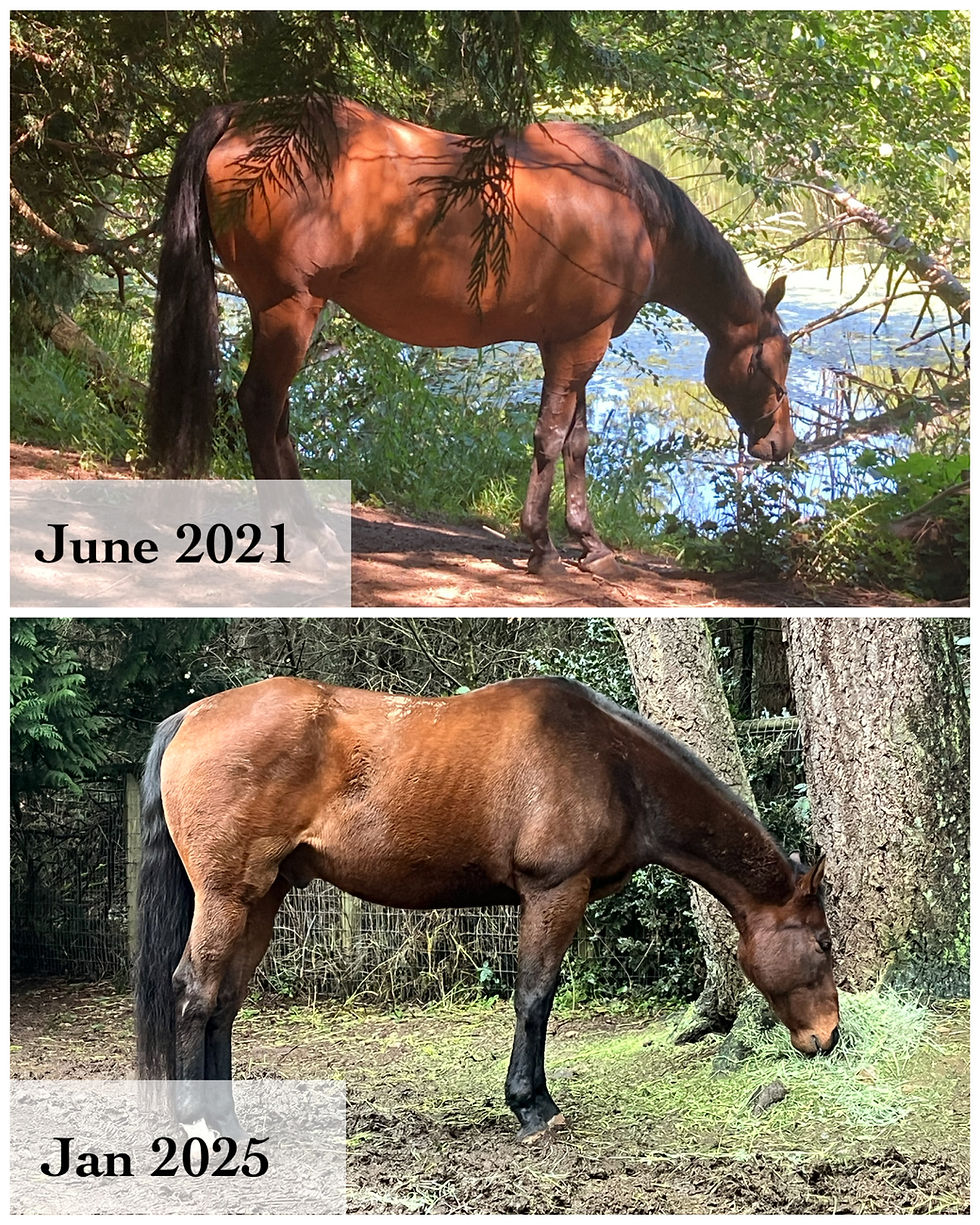
The comparison photos of Monty are dramatic.
They are also taken nearly four years apart.
That context matters, because what these images represent is not rapid weight loss or an aggressive intervention. They reflect years of consistent, evidence-based management applied within the constraints of significant injury and compromised movement capacity.
Monty originally came into my care for full-body rehabilitation. Over time, he remained and became part of my herd. From the outset, weight loss was not an aesthetic goal. It was a medical and biomechanical necessity that directly influenced his ability to heal, move, and tolerate load.
Why Weight Loss Had to Come First
Monty’s body mass was actively contributing to tissue overload and delayed healing. However, the nature of his injuries meant that conventional exercise-based weight-loss strategies were not only ineffective, but unsafe.
His case history included:
A fractured sesamoid
Pelvic dysfunction
Cranial and neurological compromise
Chronic suspensory pathology
Sidebone and advanced hoof pathology
Because of this, lunging was contraindicated. Trotting was contraindicated. Forced cardiovascular exercise was contraindicated.
Despite these limitations, weight loss still had to occur — carefully, slowly, and without further compromising already stressed systems.
The Outcome — Over Years, Not Months
To date, Monty has lost over 800 pounds.
This figure is not anecdotal. It is supported by an original veterinary weigh-in and recent weight tape measurements.
What is often missed when people see the comparison photos is the timeline behind them.
This level of change did not occur over a season or even a year. It unfolded gradually over nearly four years, with long plateaus where external change was minimal but internal adaptation was occurring.
This is the reality of true rehabilitation.
Why the Long Game Is Essential
One of the most common reasons weight-loss and rehabilitation programs fail is not because they are poorly designed, but because they are abandoned prematurely.
Two to three months is not a long-term intervention. Neither is six to eight months in situations like this. It is barely enough time for metabolic, neuromuscular, and connective tissues to begin adapting — especially in bodies that have spent years compensating.
Monty’s progress required resisting the urge to “do more” when doing more would have caused harm.
The Management Framework That Made This Possible
Monty’s program was intentionally conservative, grounded in physiology rather than optics, and sustained over years rather than weeks.
His management encompassed the following, and I adhered to them regardless of how lengthy or gradual the progress seemed:
Daily, Low-Grade Movement
He lived on a track system and participated in regular hand-walking within his tolerance. This provided continuous, low-intensity movement to support circulation, lymphatic flow, joint health, and metabolic regulation without exceeding tissue capacity.
Autonomy and Choice
He was given freedom to move and rest based on how his body responded day to day. Allowing the nervous system to downregulate is a prerequisite for tissue healing and metabolic stability.
Free-Choice Forage
He lost over 800 pounds while maintaining continuous access to hay. Forage restriction is often framed as discipline, but physiologically it drives a stress response. Elevated cortisol impairs metabolic efficiency and promotes visceral fat storage. Weight loss driven by chronic stress is not sustainable and does not support rehabilitation.
The Physiology Behind Sustainable Weight Loss
Rapid calorie restriction may reduce body weight quickly, but it does so at the expense of lean tissue and long-term metabolic health.
Gradual weight loss allows:
Preservation of muscle mass
Improved insulin sensitivity
Reduced systemic inflammation
Lower baseline cortisol levels
Visceral fat, which is closely linked to metabolic dysfunction, is particularly sensitive to stress hormones. Restricting forage elevates cortisol and makes true fat loss more difficult, not less.
These principles are not species-specific.
Before working exclusively in the equine field, my background was in human kinesiology and personal training. I coached hundreds of people through weight loss and rehabilitation.
The pattern is consistent: slow, regulated change produces durable results; aggressive intervention produces rebound.
Rehabilitation Is Not Linear
Monty’s journey has not followed a straight line.
He is currently navigating a torn meniscus, which again limits his movement capacity. During these periods, the track system becomes his primary means of maintaining joint motion and circulation when more structured movement is not possible.
This is another reason the long game matters. Setbacks do not negate progress. They require the system to adapt without abandoning the foundation.
The Broader Lesson
Monty’s case illustrates several principles that are often uncomfortable but necessary to acknowledge:
True change takes time. Undoing years of imbalance requires years of consistent input.
Foundations cannot be bypassed. No training or therapy can compensate for inadequate nutrition or lack of movement.
Progress is contextual. Healing timelines are influenced by injury history, metabolic health, nervous system state, and environment.
A Message to Caregivers
These photos represent nearly four years of daily decision-making rooted in restraint, patience, and respect for physiology.
Science can offer averages and expectations, but individual bodies adapt on individual timelines. Horses cannot be micromanaged the way humans can, which makes patience not optional, but essential.
If you are feeling discouraged after a few months with little visible change, this is your reminder:
Stay the course. Resist shortcuts. Commit to the process the horse actually needs.
Monty’s transformation is dramatic because the commitment was long-term.
That is the part worth replicating.
References
Aragon, A. A., Schoenfeld, B. J., Wildman, R., Kleiner, S., VanDusseldorp, T., Taylor, L., ... & Antonio, J. (2017). International society of sports nutrition position stand: diets and body composition. Journal of the International Society of Sports Nutrition, 14(1), 1-25.
Buff, S., Dumon, C., & Geor, R. J. (2021). Nutritional management of obesity and insulin dysregulation in horses. Equine Veterinary Education, 33(10), 524-531.
Frank, N., Geor, R. J., Bailey, S. R., Durham, A. E., & Johnson, P. J. (2010). Equine metabolic syndrome. Journal of Veterinary Internal Medicine, 24(3), 467-475.
Jansson, A., & Lindberg, J. E. (2012). Effects of forage-only diets on body weight and response to oral glucose tolerance test in standardbred horses. Equine Veterinary Journal, 44(5), 601-606.


Comments